
Utility management is moving beyond smart meters toward partners who can bring infrastructure, communications, software and operations together as an ecosystem.
“Managing utilities better” has been El Sewedy Electrometer Group’s (EMG) slogan for years. However, as the utility landscape continues to evolve, what does managing utilities better really mean?
Twenty-five years ago, when EMG developed its first prepaid meter, the question was how to address the major challenges facing utilities. Back then, these came down to three key priorities: revenue collection, load management and loss reduction.
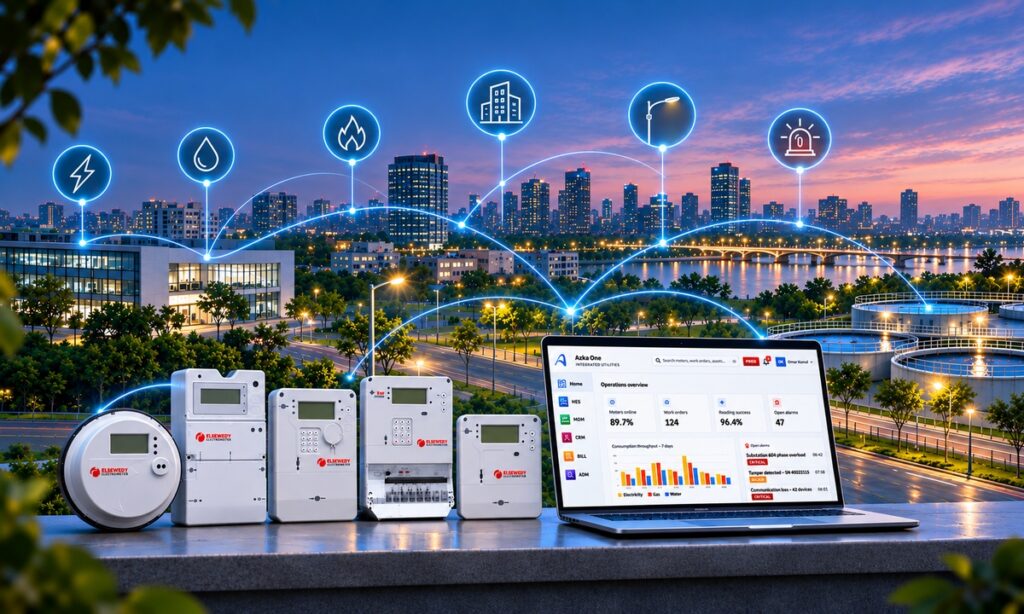
Today, the challenges are of a different nature. In a world revolving around digital transformation and AI, utilities are balancing the need to provide quality services for their customers with the pressure to keep up with rapidly evolving technology. The story is no longer about installing a smart meter and a piece of software. Smart meters are just one piece of the puzzle while the core lies in operations, connectivity, software applications, hosting, security, efficiency, workforce management, safety, ERP systems and more all working together seamlessly.
Recognising this evolution, EMG has continued to expand its capabilities beyond traditional metering technologies, measuring its success by the impact made on the utilities served. This commitment led to the establishment of AZKA Technology by EMG, bringing together dedicated teams to develop communication infrastructure, software platforms and integrated smart solutions that address the changing needs of utilities.
As utilities consider their technology investments, the focus should not be on selecting the best individual system, but on choosing a partner who understands their business, addresses their current challenges and covers their future needs, as the biggest solution is not always the best one. What matters is finding the right technology and the right partner: one that offers the flexibility to adapt, customise and evolve alongside the utility.
This is why we chose the title of this article to be ‘From smart meters to smart utilities’, because the future is not about individual technologies, but about bringing them together to help utilities manage their businesses better.
Connecting utility environments
Bringing the different layers of utility operations together starts with reliable communication. Even the most capable meter is limited if its data cannot reach the systems that need it. Depending on the deployment environment, this may involve powerline communication (PLC), radio frequency (RF) or cellular connectivity, each with its own requirements.
Meter vendors are not always the fastest to adopt new communication technologies, so selecting, integrating and managing the right mix calls for expertise that sits outside the core activities of both the utility and the meter vendor. Therefore, the utility’s partner navigates this complexity and ensures reliable, interoperable and secure communication between devices and systems.
One example is EMG’s deployment of 475,000 smart meters across Alexandria and the North Delta regions of Egypt under the JICA Lot 1 and Lot 3 projects. The deployment consisted of hybrid meters that communicate through both PRIME PLC (an open powerline communication standard) and RF, providing flexibility to transmit data across the network over wired or wireless channels. In addition to the meter deployment, EMG also used the AMI software from AZKA and integrated it with Siemens’ Advanced Distribution Management System (ADMS), connecting metering data with wider distribution network management.
Using existing technologies is only part of the partner’s role. A true technology partner also develops new technologies that simplify the utility’s operations and adapt to its evolving needs. Through AZKA, EMG has developed a unified communications modem designed to bring different communication technologies together within a single device, giving utilities greater flexibility in connecting field devices and making connectivity easier to manage.
Performance measurement to operational response
Measuring performance across a utility takes more than collecting data and generating reports. Utilities, like all businesses, need analytical tools to assess performance, software to translate data into meaningful indicators and operational systems that allow teams to respond to the problems those indicators reveal. Developing these capabilities, integrating them with existing infrastructure and making sure they reflect the utility’s actual workflows requires specialised expertise and sustained investment, on top of day-to-day network responsibilities.
A long-term partner that understands the utility can bring these capabilities together, so the utility can measure performance and address problems without developing and coordinating every element itself.
Under a long-term partnership model, reliable performance measurement starts with reliable data, which cannot be separated from reliable communication. Validation, estimation and editing (VEE) processes address gaps and inconsistencies, while analytics and AI translate data into KPIs aligned with the utility’s priorities, from network losses and meter-reading success to billing accuracy, revenue collection and communication failures.
The DSO’s partner of choice must therefore be equipped to take responsibility not only for communication but also for the utility management software platform, integrating meters, assets and sensors across the grid to generate actionable results for DSO operations teams.
Yet, identifying a problem is only the first step. Addressing it requires systems that connect performance data with day-to-day operations. For example, when a KPI flags unusually high losses in a particular area, geographic information systems (GIS) can help locate affected assets, while customer and billing data can help investigate the cause. Workforce management can coordinate field inspections or meter replacements and enterprise resource planning (ERP) can support equipment allocation and cost tracking. Subsequent measurements help determine whether the intervention worked.
A technology partner helps connect these stages for the utility, ensuring that performance data can inform decisions and support the operational response.
EMG’s work with the Electricity Company of Ghana (ECG) shows how this translates into commercial results. EMG deployed an AMI ecosystem with head-end and billing software, giving ECG clearer visibility into consumption, more accurate billing and better detection of electricity theft. Annual revenue collection rose from $13 million to $17 million, an increase of around 30%. That stronger financial footing supports the reliable supply that the government’s vision of a 24-hour economy depends on and frees ECG to focus on longer-term optimisation and loss reduction.
Beyond metering
Few suppliers can take on this role, because it takes more than a strong product. A partner needs expertise in both the physical network that generates data and the digital systems that turn it into decisions. EMG has built that range deliberately, pairing its manufacturing base with AZKA’s communication and software capabilities, so the same group stands behind the meter, the connectivity and the analytics that act on its data.
For utilities, this changes the question to ask when choosing a supplier. Instead of asking which product performs best, they can ask who is accountable for results across the whole chain, whether that means lower losses, stronger collection or more reliable service. A partner that can answer that question and keeps answering it as needs change, helps the utility manage its business better.
About El Sewedy Electrometer GroupA global leader in electricity, water and gas utility solutions, El Sewedy Electrometer Group (EMG) has been serving utilities since its founding in 1998. With 12 factories, four R&D centres and more than 35 million meters sold in over 50 countries, with its technology arm, AZKA, providing software and communications solutions.